Authoritarian / Unconstitutional: General
I gather not everyone understands why I find this so troubling. So let's talk about what we mean when we say "rule of law." More specifically, let's talk about what the Nobel Prize–winning economist Friedrich Hayek wrote about it.
“Stripped of all technicalities,” Hayek wrote, “this means that government in all its actions is bound by rules fixed and announced beforehand—rules which make it possible to foresee with fair certainty how the authority will use its coercive powers in given circumstances……and to plan one’s individual affairs on the basis of this knowledge.”
In other words, the key thing about rule of law is that we all know ahead of time what is legal and what is not, so that we can act accordingly. Obviously, it would be unjust to punish people for doing things that you never told them were forbidden.
Thus, laws need to be published. They need to be internally consistent. And they need to be *forward-looking* only. You can't retroactively declare something a crime and then go after people for things they already did.
They also need to bind government actors just as they do members of the public. That, really, is the crucial distinction between "rule of law" and its opposite, "arbitrary rule," or "rule of man," where the law just is whatever the guy in power says it is at any given moment. If the law can change from moment to moment according to the mere whim of the person in charge, you don't have rule of law as Hayek defines it — because people can't "plan [their] individual affairs" on the basis of rules that are constantly in flux.
Remember, Hayek was an economist. So he was focused on the ways in which rule of law allows markets to function. Here we can really see how the Trump administration's approach to tariffs is at odds with the idea of rule of law. If POTUS announces that a tariff of a certain amount will go into effect on a certain date against a certain country, then changes his mind a day later, then changes it again a week after that, and again in three months, and so on, he's making it impossible for anyone to plan. This introduces a huge amount of uncertainty into the system, which will have a depressive effect on economic activity as market actors have to hedge for all the endless possibilities that might be coming.
But for me, absence of rule of law is an even bigger deal when it comes to criminal law than when it comes to economic regulation. It's one thing to get hit with a tax you weren't expecting. It's another thing to be told without warning that you face punishment in the form of arrest, imprisonment, deportation, etc. Rule of law requires that everyone knows in advance what is allowed and what is not.
When it comes to the Trump administration's deportation efforts, as the original tweet shows, that is not happening. The government's lawyer admits the person "was lawfully admitted to the United States." But even the lawyer doesn't know whether he's currently here legally. So, as the judge asks—how is he supposed to know?
The government's lawyer admits the person "was lawfully admitted to the United States." But even the lawyer doesn't know whether he's currently here legally. So, as the judge asks—how is he supposed to know?
And why can't the lawyer say if the person is currently here legally? Because the Trump administration is claiming it has the right to remove an immigrant's legal status with no warning, which amounts to retroactively declaring him in violation of the law.
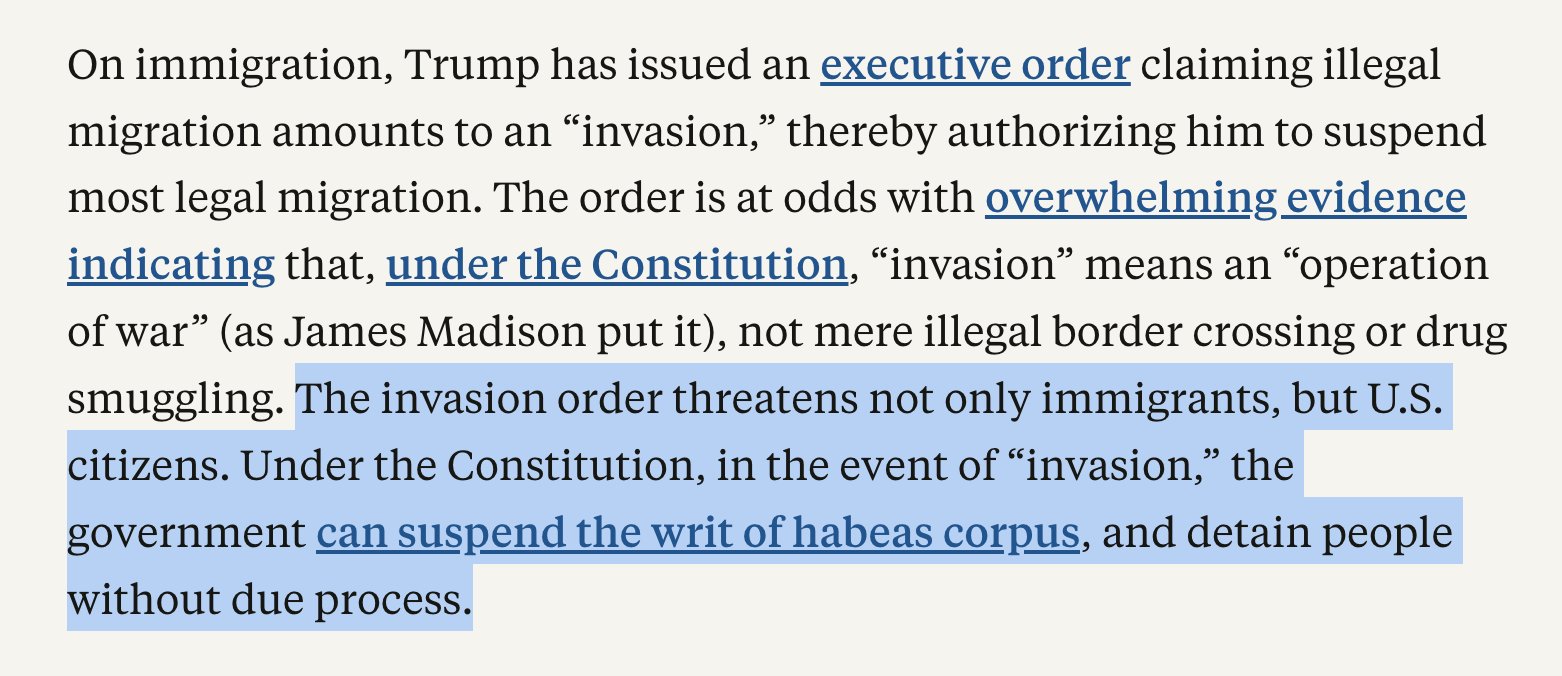
This is the opposite of rule of law as Hayek defined it, where laws must be predictable, known in advance, and stated as general principles, so that everyone has a fair opportunity to comply. And this is important to all of us, immigrants or not, because if the law can change from moment to moment, we cannot be sure that our own status (natural-born citizen, naturalized citizen, green card holder, etc.) will protect us.
Oh, and if you're inclined to think this isn't a valid concern...think again: